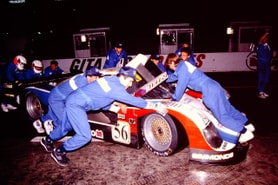
In this show, I aim to highlight the human side of professional motorsports and offer insights for those who are interested in becoming involved. While we will certainly touch on the effort and sacrifice that comes with balancing family relationships, it’s important for listeners to understand that this isn’t a story of constant negativity in the sport. In fact, it’s quite the opposite. The reality is, we’re always looking for problems—while trying to avoid creating new ones. Motorsports is a very unforgiving environment when it comes to mistakes. And at the same time we know we can win.
At every level, whether trackside or in the shop, errors can have serious consequences. A mistake could result in injury—or kill someone on track or a fan. Beyond that, there are financial ramifications, and the potential for embarrassment for your team, sponsors, and manufacturers. Because of this, nearly everyone involved in the business operates with a Type A personality.
For those unfamiliar with the term, Type A personality was first defined in the 1950s by cardiologists Meyer Friedman and Ray Rosenman. To break it down:
Type A: Characterized by high stress, urgency, competitiveness, and a constant drive to succeed.
Type B: In contrast, more relaxed, less time-sensitive, and less prone to stress.
It’s easy to see how this description applies to racers and the motorsport industry as a whole. What’s not always mentioned is that many of us actually thrive on that stress. It’s almost as if we don’t feel right without it.
At the school—yes, I reference this often because it was where my formative years in the sport unfolded—we constantly juggled multiple tasks. We ran the Russell Test Drive program using Formula Fords and, later, Formula Mitsubishis. It was essentially a fast-paced ground school on the nuances of driving: shifting a dog-box transmission, coordinating throttle blips to synchronize the Hewland/Webster Mark 8 gearbox, learning how to aim the car into and out of corners using turn-in points, and, perhaps most importantly, practicing braking exercises. The sessions were intense—four hours of in-and-out of the cars for feedback and improvement.
That was my primary driving experience—aside from occasionally shuttling the cars to be semi-useful and a few karting sessions after we added the kart track. I couldn’t afford to spend much time behind the wheel. I was building a school, and as a single dad with limited funds, I simply couldn’t justify the time or financial commitment needed to recover from potential crash damage. Employees were responsible for their crash costs, plus 10% for parts, and would do the work if a mishap occurred. So driving wasn’t in the cards for me.
I couldn’t even get the blip right, to be honest. I remember my instructor, Jeff Oppenheim, bonking me on the helmet with a rolled up yellow flag and telling me to “blip harder.” I was terrified of damaging that 78 Van Diemen Formula Ford (which was already vintage and had a nice “patina” by 1999). I still occasionally miss a shift in my ‘61 MG Midget, which has a 2-4 synchronizer, but I still try to ‘blip’—thanks to Jeff-O for that!
Understand that the instructors at the school were teaching the basics of operating a formula car on a track to anyone—literally anyone. Whether it was your mom, daughter, son, or dad, everyone got the same level of instruction. I recall Ric McCormick (RIP) once using the parts truck to teach a woman who had only ever driven an automatic how to use a manual transmission. With Ric’s expert instruction, she caught on within minutes and successfully completed the Russell Test Drive.
All of this was done with 10-15 students, many of whom had little to no hands-on mechanical experience (I’m looking at you, Joe Capelli), and a staff of 4-6 people double-checking their work. It was a high-pressure environment where Type A personalities thrived. Because, at the end of the day, any screw-up could kill someone.
But we never did kill anyone in my time there and I don’t that in all the Russell history from 1957-2009 they did.
I’ll have to ask Jacques or Bob Butte, whom you will meet soon.
The only bad crashes we had were caused by the nut behind the wheel. Some self-inflicted and some were caused by others.
The point is if these interviews sound like pessimism for the sport and the career, you are listening wrong.
There is eternal hope of the next gig after a layoff, personal setback or a team closing and mostly of winning at Indy, 24 Daytona, Sebring, Lemans, Road America, Laguna Seca, Sears Point or Buttonwillow.
As Jacques says. “If it was easy, anyone could do it.”
The question I have is, “Are you just anyone?”